Properly, the next exercise after stalls should be incipient spins, but when the time came, the wind was 5 knots straight down the runway, ideal weather for circuit training, so my instructor suggested I should start learning to land, and come back to stalls another day.

Stalling the Tiger Moth Part 2
After experiencing the stall last time, this time I get to do it for myself. But even making the aircraft fall out of the sky turns out to be less exciting than dodging other Tiger Moths, Spitfires, and even a Boeing 777.
Stalling the Tiger Moth
This weekend I got to experience the stall for the first time, and it wasn't as scary as I thought.
The wind is a Messerschmitt
Taxying a Tiger Moth in the wind can be tricky, but there's a mnemonic to help you do the right thing.
Exercise 10: slow flight
My last lesson was supposed to be about slow flight, but I learned a bigger lesson. You know those "A-ha!" moments, where you abruptly understand something? Satori, the Japanese call it. Sometimes the change in understanding is so big you even find it hard to understand how you didn't understand it before. Learning to fly seems to be a succession of such moments.
Dressing the part
Now I've had a few lessons and I'm well on my way to solo
flight, the time has come for me to invest in things to make it easier.
My old jeans and bomber jacket combo has worked well enough so far, but
as my flying career progresses, I need to upgrade to a proper flying
suit.
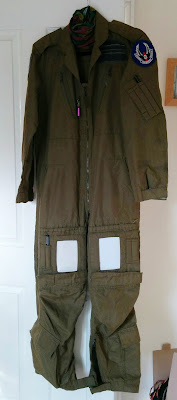 I found one the right size (or near enough) from my local
military surplus store. They're all made to a NATO standard design,
which makes shopping a lot easier. The flight suit looks like a pair of
overalls, just with more pockets. There are "knee pads" on the thighs:
not cushions like you might lean on to do the gardening, but pockets
with an open front, where you can stick a pad of paper to write things
down in flight. There's also a lot of slots for pens and pencils. I'm
told pilots lose their pens a lot, which is kind of worrying when you
think about it.
I found one the right size (or near enough) from my local
military surplus store. They're all made to a NATO standard design,
which makes shopping a lot easier. The flight suit looks like a pair of
overalls, just with more pockets. There are "knee pads" on the thighs:
not cushions like you might lean on to do the gardening, but pockets
with an open front, where you can stick a pad of paper to write things
down in flight. There's also a lot of slots for pens and pencils. I'm
told pilots lose their pens a lot, which is kind of worrying when you
think about it.
With the knee pads, I'll be able to keep track of all the information I need: the information code letter I receive on the ATIS, the current altimeter setting to use, and any radio frequencies I might need. When navigating cross-country, there's a lot more to write down: the time it took to reach each waypoint, any course deviations, and details of clearances you might receive.
There are other pockets on the sleeves, the ankles, and the chest, cleverly placed so they're still accessible in a harness. You can use them to store maps, your licence, your check-list, and two pairs of glasses if you wear them. (You have to carry a spare: it's the law.) I don't have a licence yet, but I'm supposed to carry my log book instead, so it lives in one of the ankle pockets.
The little pink thing you can see in the photo is a small LED torch. It's not a usual piece of flight equipment, but it's handy for seeing things in the dark hangar, or rooting around the bottom of the cockpit if I drop a pen.
My suit, being military surplus, came with an exciting extra: in one of the pockets, there were two sick bags (unused). I really shouldn't need them for the kind of flying I'm doing, so I've taken them out of the pocket, but I'm not sure what else to do with them. Maybe I'll save them for if I start doing aerobatics.
There are a couple of Velcro patches on the shoulders, and one on the chest, for me to attach my name badge and squadron emblem. Since I don't have a squadron, and I'm going to be flying with Cambridge Flying Group for the foreseeable future, I've chosen to nail my colours to the mast… at least, sew them to the sleeve.
I've
already made a few flights in my suit. Since it replaces my leather
bomber jacket, I put on an extra layer the first time, worried I'd be
too cold, but I was quite the opposite. The garment is a lot warmer than
it looks. Dressing to fly is quite tricky, since the air temperature
gets a lot colder the higher you go. The wind is also a factor. Imagine
driving down the motorway at 80 mph, but your windscreen only goes
halfway up your face. Last Saturday there were tears streaming down my
face where the wind got under the visor of my helmet into my eyes. I'd
made the mistake of looking straight up to see how close we were to the
clouds.
Already I can feel that donning the flying suit is becoming a part of my mental warm-up, the pre-flight ritual that gets me into the right mindset. I might not be a pilot yet, but a little dressing-up can help me feel like one.
 I found one the right size (or near enough) from my local
military surplus store. They're all made to a NATO standard design,
which makes shopping a lot easier. The flight suit looks like a pair of
overalls, just with more pockets. There are "knee pads" on the thighs:
not cushions like you might lean on to do the gardening, but pockets
with an open front, where you can stick a pad of paper to write things
down in flight. There's also a lot of slots for pens and pencils. I'm
told pilots lose their pens a lot, which is kind of worrying when you
think about it.
I found one the right size (or near enough) from my local
military surplus store. They're all made to a NATO standard design,
which makes shopping a lot easier. The flight suit looks like a pair of
overalls, just with more pockets. There are "knee pads" on the thighs:
not cushions like you might lean on to do the gardening, but pockets
with an open front, where you can stick a pad of paper to write things
down in flight. There's also a lot of slots for pens and pencils. I'm
told pilots lose their pens a lot, which is kind of worrying when you
think about it.With the knee pads, I'll be able to keep track of all the information I need: the information code letter I receive on the ATIS, the current altimeter setting to use, and any radio frequencies I might need. When navigating cross-country, there's a lot more to write down: the time it took to reach each waypoint, any course deviations, and details of clearances you might receive.
There are other pockets on the sleeves, the ankles, and the chest, cleverly placed so they're still accessible in a harness. You can use them to store maps, your licence, your check-list, and two pairs of glasses if you wear them. (You have to carry a spare: it's the law.) I don't have a licence yet, but I'm supposed to carry my log book instead, so it lives in one of the ankle pockets.
The little pink thing you can see in the photo is a small LED torch. It's not a usual piece of flight equipment, but it's handy for seeing things in the dark hangar, or rooting around the bottom of the cockpit if I drop a pen.
My suit, being military surplus, came with an exciting extra: in one of the pockets, there were two sick bags (unused). I really shouldn't need them for the kind of flying I'm doing, so I've taken them out of the pocket, but I'm not sure what else to do with them. Maybe I'll save them for if I start doing aerobatics.
There are a couple of Velcro patches on the shoulders, and one on the chest, for me to attach my name badge and squadron emblem. Since I don't have a squadron, and I'm going to be flying with Cambridge Flying Group for the foreseeable future, I've chosen to nail my colours to the mast… at least, sew them to the sleeve.
 |
| Fly Cambridge, Yoda does |
Already I can feel that donning the flying suit is becoming a part of my mental warm-up, the pre-flight ritual that gets me into the right mindset. I might not be a pilot yet, but a little dressing-up can help me feel like one.
Sharing the skies with a Dakota
The last few lessons have been mostly practice rather than learning new things. The theory and mechanics of flying a fixed-wing aircraft are pretty simple, but co-ordinating everything takes a lot of practice.
Subscribe to:
Posts (Atom)