If you were an indoorsy kid like me, the title of this post probably brings back bad memories of slogging through muddy fields in the winter rain. But today's cross-country was much more civilised: a cosy cockpit, a chart and compass, and clear views of the beautiful terrain of East Anglia. Enjoy it with me.

Visiting Duxford
You can't fly out of one aerodrome your whole career, so on this day we went for a trip to Duxford to practise circuits there, over the Imperial War Museum. It was a productive day but we had a run-in with some cowboys.
flaps
The PA-28 has a lot more switches than the Tiger Moth, but any fool can turn a switch on and off. There's one extra control that's taking me a bit longer to get used to.
New start, new type
If you've noticed my hiatus, it's because I had to take a break from flying. There was other stuff happening outside of flying, I wasn't getting enough flying time (because of weather and technical problems with the Group's aircraft) and my Tiger Moth skill wasn't progressing. So both my flying and this blog have been on hold for more than a year. But now it's time to get back into the saddle, and to avoid the problems with Tiger Moths, I've moved to a new aircraft type and a new school.
I experienced a formation flight - experience it with me
Earlier in the season, two members of Group who were going to practise formation flying very kindly asked me to come along and ride in the front seat. It was possibly the most exciting thing I've ever done. But I didn't just sit there open-mouthed for an hour: I took a video camera along, and filmed all the manoeuvres, so you can see what we did.
Landing is just the transition from flying to taxying
I'm still practising towards the perfect landing, and it's been a productive couple of months. Finally it's starting to click.
Crowded circuit flying over Cambridge
After my last hopeful post in March, it was another couple of months of bad weather, but a few weeks ago when the weather changed, it was good enough to make two flights in one day. It was a pretty challenging day, with a lot of other traffic in the circuit, and a few more reasons for it to be challenging.
New year, new ... nothing
It's been a long winter of little to no flying, so everything has got a lot worse in the interim. But the gloomy period is over, weather's getting consistently better, and I've made a breakthrough in training on the circuit.
Mishap on the ground
When you think about aviation accidents, most people would immediately think of fires or explosions in mid-air, or collisions with other aircraft, or crashing into the ground or obstructions on the ground.
My friend Chris, who is also learning to fly Tiger Moths, has generously allowed me to retell the story of an incident that befell him a couple of weeks ago. It just goes to show that sometimes it's the simple things which go wrong.
It's all up to you now: captaincy and self-reliance
Here's another vignette about trends I've noticed in my last few lessons of circuit training, in this case increasing independence.
Going round in circles
Since I last posted, I've had a few more lessons, all training for flying in the circuit. Since I've now described the circuits itself in great detail (maybe too much?), I'm going to change focus a little. Instead of trying to tell the narrative of each lesson, I'll write some shorter posts, each about one aspect of what I'm learning. I'll start with something I've noticed a lot more while hanging around the airport: traffic.
Approach to landing
Properly, the next exercise after stalls should be incipient spins, but when the time came, the wind was 5 knots straight down the runway, ideal weather for circuit training, so my instructor suggested I should start learning to land, and come back to stalls another day.
Stalling the Tiger Moth Part 2
After experiencing the stall last time, this time I get to do it for myself. But even making the aircraft fall out of the sky turns out to be less exciting than dodging other Tiger Moths, Spitfires, and even a Boeing 777.
Stalling the Tiger Moth
This weekend I got to experience the stall for the first time, and it wasn't as scary as I thought.
The wind is a Messerschmitt
Taxying a Tiger Moth in the wind can be tricky, but there's a mnemonic to help you do the right thing.
Exercise 10: slow flight
My last lesson was supposed to be about slow flight, but I learned a bigger lesson. You know those "A-ha!" moments, where you abruptly understand something? Satori, the Japanese call it. Sometimes the change in understanding is so big you even find it hard to understand how you didn't understand it before. Learning to fly seems to be a succession of such moments.
Dressing the part
Now I've had a few lessons and I'm well on my way to solo
flight, the time has come for me to invest in things to make it easier.
My old jeans and bomber jacket combo has worked well enough so far, but
as my flying career progresses, I need to upgrade to a proper flying
suit.
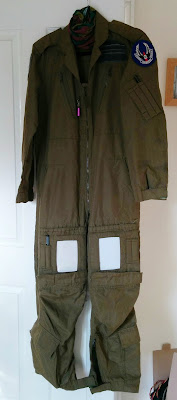 I found one the right size (or near enough) from my local
military surplus store. They're all made to a NATO standard design,
which makes shopping a lot easier. The flight suit looks like a pair of
overalls, just with more pockets. There are "knee pads" on the thighs:
not cushions like you might lean on to do the gardening, but pockets
with an open front, where you can stick a pad of paper to write things
down in flight. There's also a lot of slots for pens and pencils. I'm
told pilots lose their pens a lot, which is kind of worrying when you
think about it.
With the knee pads, I'll be able to keep track of all the information I need: the information code letter I receive on the ATIS, the current altimeter setting to use, and any radio frequencies I might need. When navigating cross-country, there's a lot more to write down: the time it took to reach each waypoint, any course deviations, and details of clearances you might receive.
There are other pockets on the sleeves, the ankles, and the chest, cleverly placed so they're still accessible in a harness. You can use them to store maps, your licence, your check-list, and two pairs of glasses if you wear them. (You have to carry a spare: it's the law.) I don't have a licence yet, but I'm supposed to carry my log book instead, so it lives in one of the ankle pockets.
The little pink thing you can see in the photo is a small LED torch. It's not a usual piece of flight equipment, but it's handy for seeing things in the dark hangar, or rooting around the bottom of the cockpit if I drop a pen.
My suit, being military surplus, came with an exciting extra: in one of the pockets, there were two sick bags (unused). I really shouldn't need them for the kind of flying I'm doing, so I've taken them out of the pocket, but I'm not sure what else to do with them. Maybe I'll save them for if I start doing aerobatics.
There are a couple of Velcro patches on the shoulders, and one on the chest, for me to attach my name badge and squadron emblem. Since I don't have a squadron, and I'm going to be flying with Cambridge Flying Group for the foreseeable future, I've chosen to nail my colours to the mast… at least, sew them to the sleeve.
I've
already made a few flights in my suit. Since it replaces my leather
bomber jacket, I put on an extra layer the first time, worried I'd be
too cold, but I was quite the opposite. The garment is a lot warmer than
it looks. Dressing to fly is quite tricky, since the air temperature
gets a lot colder the higher you go. The wind is also a factor. Imagine
driving down the motorway at 80 mph, but your windscreen only goes
halfway up your face. Last Saturday there were tears streaming down my
face where the wind got under the visor of my helmet into my eyes. I'd
made the mistake of looking straight up to see how close we were to the
clouds.
Already I can feel that donning the flying suit is becoming a part of my mental warm-up, the pre-flight ritual that gets me into the right mindset. I might not be a pilot yet, but a little dressing-up can help me feel like one.
 I found one the right size (or near enough) from my local
military surplus store. They're all made to a NATO standard design,
which makes shopping a lot easier. The flight suit looks like a pair of
overalls, just with more pockets. There are "knee pads" on the thighs:
not cushions like you might lean on to do the gardening, but pockets
with an open front, where you can stick a pad of paper to write things
down in flight. There's also a lot of slots for pens and pencils. I'm
told pilots lose their pens a lot, which is kind of worrying when you
think about it.
With the knee pads, I'll be able to keep track of all the information I need: the information code letter I receive on the ATIS, the current altimeter setting to use, and any radio frequencies I might need. When navigating cross-country, there's a lot more to write down: the time it took to reach each waypoint, any course deviations, and details of clearances you might receive.
There are other pockets on the sleeves, the ankles, and the chest, cleverly placed so they're still accessible in a harness. You can use them to store maps, your licence, your check-list, and two pairs of glasses if you wear them. (You have to carry a spare: it's the law.) I don't have a licence yet, but I'm supposed to carry my log book instead, so it lives in one of the ankle pockets.
The little pink thing you can see in the photo is a small LED torch. It's not a usual piece of flight equipment, but it's handy for seeing things in the dark hangar, or rooting around the bottom of the cockpit if I drop a pen.
My suit, being military surplus, came with an exciting extra: in one of the pockets, there were two sick bags (unused). I really shouldn't need them for the kind of flying I'm doing, so I've taken them out of the pocket, but I'm not sure what else to do with them. Maybe I'll save them for if I start doing aerobatics.
There are a couple of Velcro patches on the shoulders, and one on the chest, for me to attach my name badge and squadron emblem. Since I don't have a squadron, and I'm going to be flying with Cambridge Flying Group for the foreseeable future, I've chosen to nail my colours to the mast… at least, sew them to the sleeve.
 |
| Fly Cambridge, Yoda does |
Already I can feel that donning the flying suit is becoming a part of my mental warm-up, the pre-flight ritual that gets me into the right mindset. I might not be a pilot yet, but a little dressing-up can help me feel like one.
Sharing the skies with a Dakota
The last few lessons have been mostly practice rather than learning new things. The theory and mechanics of flying a fixed-wing aircraft are pretty simple, but co-ordinating everything takes a lot of practice.
Chris' first take off and landing in a Tiger Moth
My friend Chris, who's also learning ab initio on a Tiger Moth, successfully completed his first take-off and landing yesterday. Congrats, Chris! I hope I'll be joining you soon.
British engineering and ingenuity
Sometimes aircraft develop faults, especially when they've been flying for more than 60 years. Some faults are serious enough to prevent flight, such as the undercarriage problem that kept EI in the mechanic's for a few months. Others you just have to make do and mend.
Subscribe to:
Posts (Atom)